Family court records in Nevada contain information related to legal matters such as divorce, child custody, guardianship, and other family-related issues. These records help illustrate how such cases are handled within the state’s judicial system, offering insight into the legal framework governing domestic situations. They are often referenced for general understanding or educational purposes.
Individuals may look into Nevada family court records to gain a clearer picture of legal outcomes involving family law. These records can highlight the court’s role in resolving personal and sensitive disputes. It is important to understand that I only provide general information and do not give access to any official documents or materials.
How to Access Nevada Family Court Records
Accessing Nevada family court records requires understanding which documents are publicly available, where to search through official court systems, and what information is needed to complete a successful request. Nevada Court Records provide insight into legal matters such as divorce proceedings, child custody arrangements, support orders, and property division cases. Nevada courts allow public access to certain records; however, strict privacy laws protect sensitive information. Records must only be used for lawful, informational purposes through official court channels.
Publicly Available Nevada Family Court Records
Not all family court documents are open to the public. Nevada law automatically restricts records involving minors or confidential matters. Generally, the following records may be accessible unless sealed by court order:
- Divorce decrees (if not sealed)
- Child custody agreements
- Child and spousal support orders
- Property division rulings
Records Commonly Restricted
Certain family court documents are protected to preserve privacy and prevent misuse of sensitive legal information. Courts carefully limit access where disclosure could affect children, victims, or confidential financial matters.
The court may block access to:
- Adoption proceedings
- Juvenile cases
- Domestic violence filings
- Documents containing medical or financial data
- Social Security or confidential identifying information
Official Nevada Court Websites
All searches should begin using official judiciary portals to ensure accuracy and lawful access to records.
Nevada Judiciary (State Court Portal)
The statewide judiciary website acts as the central directory for locating district courts, accessing court resources, and identifying the correct county where a family case was filed.
Naked URL: https://nvcourts.gov
Clark County Family Court (Las Vegas Area)
This court manages the majority of Nevada’s family law filings and provides an online Smart Search system for public case lookup and record review.
Operated by the Eighth Judicial District Court URL: https://www.clarkcountycourts.us
Washoe County District Court (Reno Area)
Washoe County offers its own online records system where users can review public case summaries and request copies of eligible documents.
URL: https://www.washoecourts.com
How to Search Nevada Family Court Records Online
Most users access records online using the official Smart Search case lookup tool provided by county courts.
Open the Official Court Website
Start by visiting the Clark County Courts website and navigating to the case lookup section. This ensures you are using an official government database rather than a third-party source.
Go to: https://www.clarkcountycourts.us
From the homepage:
Select Court Case Lookup
Open Smart Search
Open Smart Search Tool
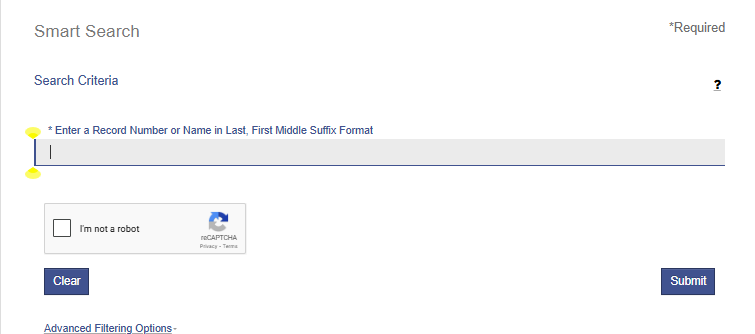
The Smart Search interface allows users to locate cases using minimal information. It connects directly to the court’s internal public records database.
You will see a search box labeled:
“Enter a Record Number or Name in Last, First Middle Suffix Format.”
Enter the Name Correctly (Important)
Correct formatting is essential because the system searches exact database entries. Incorrect name order may return no results even if the case exists.
Use this exact format:
Last Name, First Name
Correct:
- Smith, John
- Garcia, Maria
Incorrect:
- John Smith
- Smith John
If available, entering a case number produces faster and more accurate results.
Complete Security Verification
Before accessing records, the court requires identity verification through a CAPTCHA system to prevent automated searches and protect database integrity.
- Check I’m not a robot
- Complete any image verification if requested.
Click Submit
After entering the search information, submitting the request sends a query to the court database and generates matching results based on available public records.
Press Submit to display matching court cases.
The system will show:
- Case numbers
- Filing dates
- Case status
- Court department
Review Case Information
Once a case is opened, users can review available public details. The level of access depends on court permissions and privacy restrictions tied to the case type.
Depending on availability, users may view:
- Case summaries (docket entries)
- Hearing schedules
- Filing history
- Publicly available documents
Requesting Records In Person
When online access is unavailable, visiting the courthouse provides an alternative method for obtaining official or certified documents.
When In-Person Requests Are Required
Courthouse visits are typically necessary for older cases or documents requiring authentication by court staff.
- Records are older or archived
- Certified copies are required
- Online access is restricted
- Additional identity verification is necessary
Bring:
- Government-issued photo ID
- Case number or party names
- Approximate filing date
Essential Information Needed for Record Searches
Providing accurate details significantly improves search success and reduces processing delays.
Required Search Information
Courts rely on identifying information to locate files within large databases containing thousands of cases.
Prepare the following:
- Full legal names of parties involved
- Case number (if available)
- Filing year or approximate date
- County or court location
Fees for Nevada Family Court Records
Costs vary depending on whether documents are viewed online, printed, or officially certified.
Typical Court Fees
Fees help cover administrative processing and document certification services provided by court clerks.
| Service | Typical Cost |
|---|---|
| Online docket viewing | Usually Free |
| Printed copies | $1–$10 per page |
| Certified copies | Additional certification fee |
Processing Times
Processing duration depends on how records are requested and whether additional verification is required.
Estimated Processing Timeframes
Digital systems provide faster access, while manual processing may require additional review by court staff.
- Online searches: Immediate access (if available)
- Mail or in-person requests: 5–15 business days
- Certified records: May require additional processing time
Common Reasons Access May Be Denied
Courts may deny requests to maintain privacy protections and ensure compliance with legal access rules.
Possible Denial Causes
Understanding these reasons helps users correct errors before resubmitting a request.
- Record is sealed or confidential
- Insufficient identifying information
- Incorrect or incomplete submission
- Request made for prohibited screening purposes
Types of Family Court Cases in Nevada
Nevada’s family courts handle a wide range of legal matters related to personal and familial relationships. Understanding the different types of cases processed through these courts helps individuals navigate available records responsibly. Nevada Court Records provide valuable context for those researching these family-related legal matters. Please note: All information referenced here is intended strictly for personal use only. Any commercial use including employment screening, housing decisions, or credit evaluations is strictly prohibited under the Fair Credit Reporting Act (FCRA) and other applicable compliance guidelines.
Divorce and Legal Separation Proceedings
Divorce and separation cases in Nevada fall under NRS Chapter 125 and involve the legal dissolution or reclassification of a marriage. These legal proceedings are closely related to marriage records, which document the original union before any court action occurs. Court records in these matters may include:
- Petitions for divorce or separation
- Marital settlement agreements
- Orders for spousal support and property division
- Temporary restraining orders or custody arrangements
While some filings may be public, others—especially those involving financial or sensitive family information—may have limited access depending on court discretion.
Child Custody, Child Support, and Visitation Orders
Cases involving minor children address issues such as legal custody, physical custody, child support, and visitation rights. These proceedings are typically guided by NRS Chapters 125 and 125B. Documents may include:
- Custody determinations and parenting plans
- Child support calculation worksheets
- Court-issued visitation schedules
- Modifications to prior orders
These records emphasize the court’s goal of ensuring a child’s welfare and may contain detailed arrangements for each parent’s responsibilities. Access to such records may be limited in certain situations to protect the interests of minors.
Guardianship and Paternity Determinations
Guardianship cases, governed by NRS Chapter 159, involve the legal appointment of an individual to care for a minor or an adult with diminished capacity. Common documents found in these cases include:
- Petitions for guardianship
- Court evaluations and annual reports
- Orders granting or terminating guardianship
Paternity cases, generally filed under NRS Chapter 126, are used to establish legal fatherhood. Records in these cases may involve:
- Genetic testing orders
- Legal findings of paternity
- Child support enforcement orders
These cases often influence legal responsibilities such as support and visitation, and access may be restricted depending on the circumstances involved.
Adoption and Domestic Partnership Dissolution
Adoption proceedings (under NRS Chapter 127) formalize the legal relationship between a child and adoptive parents. Because of the sensitive nature of these cases:
- Most adoption records are sealed once finalized
- Access requires a court order in most cases
Domestic partnership dissolution, relevant to couples registered under Nevada’s domestic partnership laws, follows procedures similar to divorce. Records typically include:
- Petitions for dissolution
- Settlement of jointly owned assets
- Support agreements or custody arrangements (if applicable)
These cases allow domestic partners to legally separate and resolve shared obligations, mirroring the process of traditional marital dissolutions.
Nevada Small Claims Cases
Small claims courts in Nevada offer individuals a streamlined and cost-effective way to resolve minor civil disputes. These courts are specifically designed for straightforward cases involving limited monetary amounts, allowing parties to present their case without the need for complex legal procedures or formal representation. Nevada’s small claims process prioritizes accessibility, making it a practical option for resolving qualifying disputes at the local level.
What Qualifies as a Small Claims Case in Nevada?
A case qualifies for Nevada small claims court if the amount in controversy does not exceed $10,000. This limit is set by statute and may be subject to change depending on jurisdictional updates. Claims must be civil in nature and involve disputes between private parties. Examples include claims for unpaid personal debts, damage to property, and breaches of informal contracts.
- The amount sought must be within the $10,000 limit
- The case must be civil, not criminal
- The defendant must reside in Nevada or the dispute must have occurred in the state
- The plaintiff must be an individual or self-represented party (not using the court for business or commercial collections)
Cases involving criminal conduct, eviction, domestic relations, or any issue requiring complex legal procedures fall outside the scope of small claims court and must be filed in the appropriate court division.
Jurisdiction and Filing Limitations
Jurisdiction for small claims cases is based on the location of the defendant or the place where the dispute occurred. Typically, cases must be filed in the Justice Court within the proper Nevada township.
- Attorney representation is generally not allowed unless specifically permitted by the court.
- The parties are expected to present their own evidence, statements, and witnesses.
- Discovery procedures, formal pleadings, and motions are restricted to keep the process efficient and fair.
Using the small claims process to pursue commercial claims under the guise of personal disputes or to recover business-related debts violates both Nevada court procedure and federal guidelines related to personal data and fair use.
Types of Disputes Handled in Nevada Small Claims Court
Small claims courts are designed to resolve uncomplicated civil disagreements involving personal matters. Common disputes include:
- Unpaid personal loans between friends, family members, or acquaintances
- Property damage resulting from accidents, misuse, or negligence
- Disagreements over services rendered without formal contracts
- Security deposit disputes where landlords and tenants disagree about amounts owed
- Breach of informal agreements, such as payment for used goods or shared expenses
- Loss or wrongful retention of personal property
Each case must present clear facts, including who is owed what, why the claim is being made, and how the requested amount is calculated. Proper documentation—such as written agreements, receipts, and photos—can significantly improve the likelihood of a favorable outcome.
Nevada Class Action Lawsuits
A class action lawsuit in Nevada is a legal mechanism that allows one or more individuals to represent a larger group of people known collectively as a “class” who have experienced similar legal issues. These lawsuits are governed by Rule 23 of the Nevada Rules of Civil Procedure, which outlines the specific conditions a case must meet to be certified as a class action.
- The legal or factual questions are common across the group,
- The class representatives can fairly and adequately protect the interests of the group, and
- A class action is the most appropriate and efficient way to resolve the matter.
This rule is modeled after Federal Rule of Civil Procedure 23 and ensures consistency in how class actions are evaluated and processed. Courts review each proposed class carefully to ensure the standards are met before certification is granted.
Key Differences Between Individual and Class Action Cases
The main distinction between an individual lawsuit and a class action lies in scale and procedure.
- Individual Lawsuit: Filed by one person for a personal legal grievance. The result only affects that individual.
- Class Action Lawsuit: Filed by a representative plaintiff on behalf of many others with similar legal claims. The outcome may impact everyone included in the certified class.
Class actions are especially valuable when individual claims might be too small to justify the cost of separate legal action. They promote judicial efficiency and offer access to remedies for large groups of affected individuals. Most members of the class are automatically included unless they choose to opt out after receiving court-authorized notice.
It’s important to note that participation in a class action does not require initiating your own lawsuit or appearing in court. However, affected individuals retain the right to opt out and pursue their own legal action if they prefer.
Examples of Class Action Cases in Nevada
While every case is unique, Nevada has seen several types of class action lawsuits in recent years. These include claims related to:
- Consumer Overbilling: Cases where residents alleged that companies charged improper or excessive fees for services.
- Employment Classification Disputes: Legal actions brought by workers who claimed they were misclassified as independent contractors rather than employees.
- Product Liability and Consumer Claims: Lawsuits filed over the alleged sale of defective products or misleading advertising practices.
These lawsuits typically begin when a lead plaintiff identifies a widespread issue affecting a group of people. If the court agrees that the issue meets the criteria of Rule 23, the class is certified, and the case proceeds on behalf of all qualified class members.
Settlements in class actions must be approved by the court to ensure fairness. Compensation is often distributed based on the number of valid claims filed, and settlement details are usually communicated through public notices or mailed correspondence.
Important Considerations for Public Awareness
Participation in a class action is voluntary once notice is received. Affected individuals should read all documentation carefully and understand their rights before taking any action.
This section provides general educational information and should not be used as a substitute for legal advice. If you’re unsure whether you’re part of a specific class action or have legal concerns, consider consulting a qualified attorney or accessing information from official court sources.
How to Find Records Related to Small Claims or Class Actions in Nevada
Navigating Nevada’s court records can be straightforward when you understand where to look and what information is required. Small claims and class action lawsuits are part of the state’s public judicial system, and many records can be accessed through government-maintained portals. However, it’s essential to use these records for personal reference only and never for commercial, employment, or tenant screening purposes, in accordance with federal and state legal standards.
Using Nevada’s Official Court Record Portals
Nevada’s court system provides online platforms to help individuals access public case information. These portals are designed to offer convenient, transparent access to filings, hearing schedules, and docket summaries. Key platforms include:
- Nevada Appellate Courts Case Lookup – for Supreme Court and Court of Appeals records.
- Clark County Eighth Judicial District Court Portal – for civil, criminal, and small claims cases filed in Clark County.
- Washoe County Case Inquiry – for district-level and civil cases, including small claims matters.
When using these portals, you’ll typically need one or more of the following:
- Full name of a party involved
- Case or docket number
- Approximate filing date
- County or jurisdiction where the case was filed
County-by-County Lookup: Clark, Washoe, and Carson City
Because Nevada’s courts are organized by judicial district, search procedures vary by location. Here’s how to approach records access in the three most prominent counties:
Clark County
Clark County maintains one of the most robust online systems in the state. Through the Eighth Judicial District Court Portal, you can search for small claims, civil cases, and class action filings. The site offers case summaries and downloadable documents, when permitted.
Washoe County
The Washoe Courts Public Access Portal provides digital access to civil filings, including small claims disputes. Be aware that sealed or protected records, such as certain class actions or cases involving minors, will not be available through online search.
Carson City
In Carson City, public court access is more limited online. However, the city’s official website directs users to contact the courthouse clerk for help accessing civil case documents. Be prepared to file a written request or appear in person to view physical case files.
Essential Information Required to Locate a Case
Before beginning your search, gather as much case-specific information as possible. Nevada courts typically require the following to initiate a search:
- Full legal name of one of the parties
- Case number or docket ID (if available)
- County or court district where the case was filed
- Filing year or date range
- Case type (e.g., small claims, class action, civil)
Providing complete and accurate information improves your chances of locating the correct records and reduces the risk of receiving incomplete or mismatched results.
Legal and Official Resources
Access to accurate legal resources is essential for individuals seeking clarity on Nevada family court records, small claims cases, or class action procedures. This section provides reliable links to official court websites, directories, forms, and contact information. All resources listed here are intended strictly for personal use and must not be utilized for any commercial, employment, credit, or tenant screening purposes.
Nevada Judiciary Website
The Nevada Judiciary’s official website serves as the central authority for all court-related information in the state. It offers up-to-date court calendars, judicial announcements, public access policies, and structural overviews of Nevada’s Supreme, District, and Justice Courts. This site helps individuals understand the state’s court hierarchy and locate jurisdiction-specific guidance.
District and Justice Court Directories
Nevada’s courts are divided into District Courts (handling family law and civil matters) and Justice Courts (handling small claims and limited civil actions). Each court operates independently, and jurisdictions may differ across counties. Users seeking court locations, filing instructions, or jurisdictional insight should consult:
- Statewide Court Directory
- Clark County Courts
- Washoe County Courts
- Carson City Justice/Municipal Court
These directories provide courthouse addresses, hours of operation, division overviews, and links to each court’s individual portal. Always verify the appropriate jurisdiction before initiating any filing.
Court Forms and Fee Schedules
Most Nevada courts provide downloadable forms for self-represented individuals pursuing family court matters or small claims actions. Commonly requested forms include:
- Divorce and custody packets
- Name change applications
- Small claims complaints
- Request for hearing or judgment forms
You may find these forms through:
- Nevada Self-Help Center
- Clark County Family Court Forms
- Washoe County Legal Forms
Court fee schedules covering filing costs, certified copies, and document retrieval are also listed on each county’s website. Please note that fees may vary by case type and jurisdiction. Users should not interpret availability of forms as permission to use them for regulated screenings or business decisions.
Clerk of Court Contact Information
Court clerks serve as the primary administrative point of contact for court-related procedures. They manage filings, maintain records, and provide basic guidance on court access. However, clerks cannot offer legal advice or draft legal documents. Below are key contacts:
| Court Clerk Office | Website | Phone Number |
|---|---|---|
| Clark County District Court Clerk | Clark County Courts | (702) 671-4528 |
| Washoe County Court Clerk | Washoe Courts | (775) 328-3110 |
| Nevada Supreme Court Clerk | Nevada Supreme Court | (775) 684-1600 |
| Carson City Justice Court Clerk | Carson City Court | (775) 887-2121 |
For the most accurate and current information, always contact the court directly or visit its official website.
Frequently Asked Questions
Below are some frequently asked questions to help readers better understand Nevada Family Court Records. Please note that we do not provide FAQs directly—these are published on our website and intended for informational purposes only.
What are Nevada family court records?
Nevada family court records are official documents that detail proceedings and decisions in family law cases. These may include matters related to divorce, child custody, spousal support, adoption, and guardianship. The records may contain petitions, motions, orders, judgments, and hearing transcripts. While some information may be available to the public, sensitive data is often restricted. These records help maintain a legal history of family-related court decisions in Nevada.
Are all Nevada family court records public?
Not all Nevada family court records are public. While some cases may be accessible for general viewing, many records involving minors, abuse allegations, or adoption are sealed by the court. This means access is restricted to involved parties, attorneys, or others with legal permission. The Nevada court system takes privacy seriously, especially in sensitive family law matters. Laws are in place to ensure personal information is protected from unauthorized disclosure.
How can someone request access to family court records in Nevada?
Access to family court records in Nevada typically begins with a request made through the court where the case was filed. In most cases, the requester must provide case details such as names of parties, case number, or filing date. Courts may require identification or a written request, and some records may only be accessed by parties directly involved in the case. Online portals exist in some districts, but sealed records remain protected.
What types of cases are included in Nevada family court records?
Nevada family court records include a broad range of case types under family law. Common records involve divorce, child custody, legal separation, spousal or child support, adoption, name changes, and guardianship. Each case type generates documents such as petitions, affidavits, court orders, and final judgments. These records serve as legal documentation of each step taken in the resolution of family disputes within Nevada courts.
Can family court decisions in Nevada be appealed?
Yes, family court decisions in Nevada can be appealed, but the process must follow specific legal timelines and procedures. A party who disagrees with the court’s ruling may file an appeal with the Nevada Supreme Court or appropriate appellate court. The appellate court will review the records to determine if legal errors occurred during the trial. The original family court records play a crucial role in the appeal, as they form the basis for judicial review.